
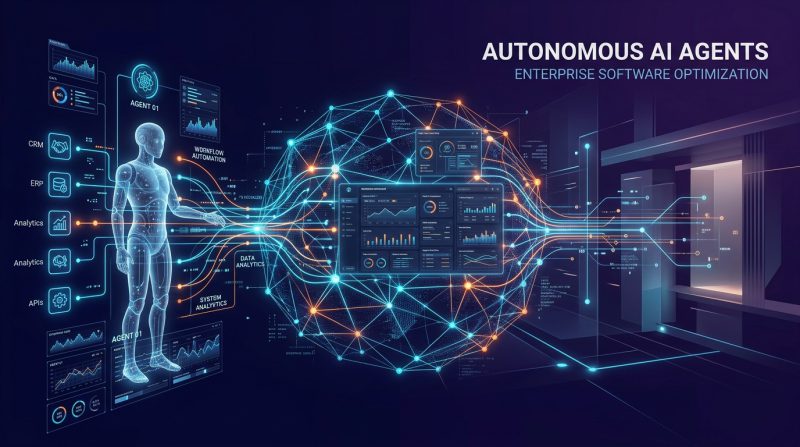
Autonomous AI Agents in Enterprise Software: How Next-Gen AI is Transforming Business Operations in 2026
Discover how autonomous AI agents are moving beyond conventional chatbots to orchestrate multi-step business workflows, accelerate custom software development, and deliver measurable enterprise ROI in 2026.
Artificial Intelligence has undergone a historic evolution. While the previous phase of generative AI was characterized by conversational chatbots and simple question-answering prompts, 2026 marks the definitive arrival of Autonomous AI Agents.
Modern enterprises are no longer satisfied with AI systems that merely summarize PDFs or draft generic emails. Forward-thinking companies demand AI architectures that can act — reasoning through complex business objectives, connecting seamlessly to live corporate databases, invoking APIs autonomously, and executing end-to-end tasks without constant human babysitting.
What Exactly Are Autonomous AI Agents?
Unlike traditional automation scripts that follow rigid “if-this-then-that” logic, an Autonomous AI Agent is an intelligent system equipped with cognitive reasoning, working memory, and tool-use capabilities.
When given a high-level goal — such as “Analyze customer churn from Q3, identify recurring friction points, and prepare a personalized re-engagement campaign” — an AI agent performs four distinct steps:
- Decomposition & Planning: Breaks the large objective down into sequential, manageable sub-tasks.
- Standardized Tool Calling (MCP & APIs): Uses protocols like the Model Context Protocol (MCP) and REST APIs to fetch CRM data, query databases, and interact with SaaS tools.
- Self-Correction & Reflection: Evaluates intermediate outputs. If an API returns an error or data is missing, the agent re-plans and adapts its parameters dynamically.
- Human-in-the-Loop Governance: Executes safe actions automatically while requesting human authorization for sensitive business decisions (such as high-value transactions or data modifications).
3 High-Impact Enterprise Use Cases for AI Agents in 2026
1. Accelerated Custom Software Engineering & QA
Software development organizations are adopting agent swarms to augment engineering velocity. While senior system architects define core architecture and security guidelines, autonomous coding agents:
- Generate clean, modular boilerplate code tailored to company-specific repositories.
- Write and execute comprehensive unit, integration, and regression test suites.
- Scan pull requests for security vulnerabilities, API latency bottlenecks, and edge cases prior to deployment.
2. Intelligent ERP, HR & Workforce Automation
Enterprise resource planning and human resource management often involve high manual overhead. Autonomous agents integrate directly into core ERP systems to:
- Streamline employee onboarding by automating documentation verification, role-based tool provisioning, and compliance checks.
- Continuously reconcile cross-department payroll data, identifying tax anomalies before month-end closures.
- Provide round-the-clock employee self-service capable of resolving complex policy inquiries backed by live records.
3. Real-Time Customer Experience & Service Automation
Traditional chatbots frustrate users because they cannot solve problems — they only recite FAQ articles. Autonomous AI agents, by contrast, possess operational agency:
- Verify user identities securely against enterprise authentication systems.
- Query warehouse inventory management systems in real time to process order tracking, address changes, or refunds.
- Update CRM platforms with detailed summaries, sentiment tracking, and predictive churn metrics.
Key Architectural Considerations Before Deploying AI Agents
“True enterprise agility in the AI era is not about deploying the largest model — it is about designing resilient agent architectures with strict security boundaries, comprehensive observability, and reliable tool integration.”
Before introducing autonomous agents into production environments, enterprise IT leaders must address three core pillars:
- Strict Permission Sandboxing: Implement zero-trust access principles. AI agents must operate under least-privilege API tokens with granular rate-limiting and environment isolation.
- Complete Action Observability: Maintain tamper-proof, auditable logs detailing every prompt, tool call, external response, and decision branch for regulatory compliance.
- Hybrid Model Orchestration: Route high-volume, low-complexity tasks to efficient smaller models, reserving high-reasoning frontier models for multi-step reasoning to balance performance with cloud expenditure.
Build Your Future-Ready AI & Software Solutions with Exact IT Solutions
Successfully capitalizing on autonomous AI agents requires deep technical proficiency across enterprise backend architectures, robust API integrations, cloud scalability, and human-centric UI/UX design.
With over 14 years of proven technology delivery since 2012, Exact IT Solutions Pvt. Ltd. is a trusted software engineering and digital transformation partner for businesses across India and internationally. Whether you need bespoke enterprise software development, modern web applications, high-performance mobile apps, or next-generation AI integrations, our dedicated engineering team delivers solutions engineered for growth and reliability.
Ready to Accelerate Your Enterprise with Intelligent Software?
Speak with our technology consultants to explore how tailored software and AI automation can transform your business operations.